
 Image 1 of 1
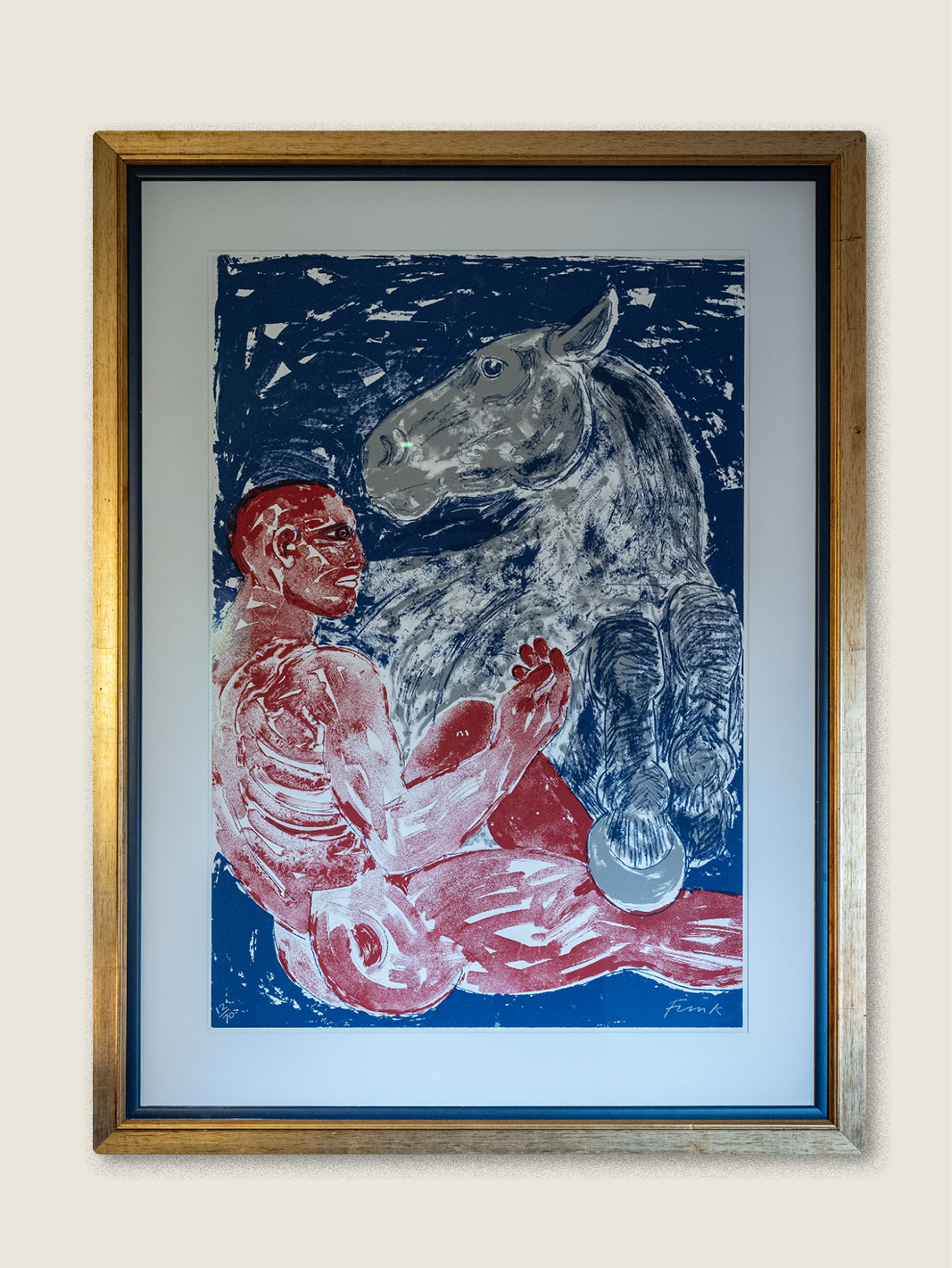
Original Screenprint
Signed & Numbered 12/70
Dimensions: 132cm x 100cm
Frink was an English sculptor and printmaker. Her Times obituary noted the three essential themes in her work as "the nature of Man; the 'horseness' of horses; and the divine in human form"
Although she made many drawings and prints, she is best known for her bronze outdoor sculpture.
In the 1960s Frink's continuing fascination with the human form was evident in a series of falling figures and winged men. While living in France from 1967 to 1970, she began a series of threatening, monumental male heads, known as the goggled heads. On returning to England, she focused on the male nude, barrel-chested, with mask-like features, attenuated limbs and a pitted surface. Frink's sculpture, and her lithographs and etchings drew on archetypes expressing masculine strength, struggle and aggression. In 1984 she explained that she "focused on the male because to me he is a subtle combination of sensuality and strength with vulnerability".
Having been elected a full Academician at the Royal Academy in 1979, there were moves to make the 54-year-old sculptor the first female president of the academy, Frink however did not want the post.
Warhorse and Walking Madonna may be seen in the garden at Chatsworth House. Other work is at the Jerwood Sculpture Park at Ragley Hall. Uniquely in England, Desert Quartet (1990), Frink's penultimate sculpture, was listed at Grade II* in 2007, less than 30 years from its creation by the Department for Culture, Media and Sport. It may be seen opposite Liverpool Gardens in Worthing. Her 1975 bust of John Pope Hennessey is in the collection of the British Museum.[
Original Screenprint
Signed & Numbered 12/70
Dimensions: 132cm x 100cm
Frink was an English sculptor and printmaker. Her Times obituary noted the three essential themes in her work as "the nature of Man; the 'horseness' of horses; and the divine in human form"
Although she made many drawings and prints, she is best known for her bronze outdoor sculpture.
In the 1960s Frink's continuing fascination with the human form was evident in a series of falling figures and winged men. While living in France from 1967 to 1970, she began a series of threatening, monumental male heads, known as the goggled heads. On returning to England, she focused on the male nude, barrel-chested, with mask-like features, attenuated limbs and a pitted surface. Frink's sculpture, and her lithographs and etchings drew on archetypes expressing masculine strength, struggle and aggression. In 1984 she explained that she "focused on the male because to me he is a subtle combination of sensuality and strength with vulnerability".
Having been elected a full Academician at the Royal Academy in 1979, there were moves to make the 54-year-old sculptor the first female president of the academy, Frink however did not want the post.
Warhorse and Walking Madonna may be seen in the garden at Chatsworth House. Other work is at the Jerwood Sculpture Park at Ragley Hall. Uniquely in England, Desert Quartet (1990), Frink's penultimate sculpture, was listed at Grade II* in 2007, less than 30 years from its creation by the Department for Culture, Media and Sport. It may be seen opposite Liverpool Gardens in Worthing. Her 1975 bust of John Pope Hennessey is in the collection of the British Museum.[